

Bhadohi Rugs
Hand-Tufted vs Hand-Knotted Rugs: The Honest Difference (and Which Is Worth Your Money)

ThePieCraft Buyer's Guide & Masterclass
By ThePieCraft Studio, Bhadohi, India · Updated October 2026
You've found a wool rug you love. Then you see two listings that look almost the same, one labeled "hand-tufted" and one labeled "hand-knotted", and the knotted one costs two or three times as much. Is it worth it, or are you paying for a word?
The short version of the hand tufted vs hand knotted rugs question is this: both are made by hand, but in very different ways. That fundamental difference decides the price, how long the rug lasts, how it feels underfoot and which room it belongs in. We make authentic Bhadohi rugs in India's best-known rug-weaving region, so this guide gives you the version a rug maker would tell a friend, not a salesperson's version.

⚡ Quick Answer: Which Rug Construction Is Right for You?
- Hand-knotted rugs are tied one knot at a time on a vertical loom. A large rug takes about 4–6 months to weave, can last for generations (50–100+ years), and carries the highest price tag.
- Hand-tufted rugs are crafted by punching premium yarn through a stretched canvas with a hand-held tufting gun, then permanently securing the pile with a flexible latex compound and protective cotton backing. They take 4–8 weeks, cost less than half as much as knotted rugs, and with premium wool and care easily last 15 to 25 years.
- The buying decision: Choose knotted if you are seeking a museum-grade heirloom or intricate, traditional Persian floral medallion. Choose tufted if you want a soft, plush, sculptural modern rug at a sensible price for a living room, bedroom, or family space.
Below we break down exactly how each rug is made, what you're actually paying for, how to tell them apart in person, and which one fits the room you're shopping for.
How a Hand-Knotted Rug Is Made
A hand-knotted rug starts on a vertical loom strung with cotton or wool threads, called the warp. A master weaver ties each individual strand of wool around a pair of warp threads, cuts it with a curved knife, and moves to the next adjacent thread. After every completed row of knots, horizontal weft threads are passed through and vigorously beaten down tight using a heavy iron comb. Then the next row begins.
Because every single knot is tied individually by human hands, knot density is the definitive measure of quality. This is quantified in knots per square inch (KPSI). KPSI runs from roughly 40 in coarse tribal or village rugs to well over 1,000 in museum-grade pure silk pieces. Anything above about 100 KPSI is generally considered good quality, while intricate, detailed designs demand 200 to 400 KPSI or more (Hali).
This is slow, physically punishing work. An experienced master artisan may tie between 6,000 and 10,000 knots per day, advancing only a few square inches. A standard wool area rug 8x10 hand-knotted typically requires 4 to 6 months of continuous daily weaving (FCI London), while ultra-fine pieces can stretch past a year. Bhadohi's handmade carpets were awarded a prestigious Geographical Indication (GI) tag in 2010 by the Government of India for exactly this centuries-old loom craft (Varanasi district, Govt. of India).
How a Hand-Tufted Rug Is Made
A hand-tufted rug starts with full-scale graphic artwork traced precisely onto high-tensile cotton canvas cloth stretched drum-tight across an upright wooden or steel frame. An artisan uses an electric or manual tufting gun to shoot continuous loops of yarn through the canvas, meticulously tracing the design line by line, shape by shape, and color by color.

Once the front face is completely filled with dense wool loops, a vulcanized layer of natural latex backing is applied across the reverse side to permanently lock every tuft into the foundation. A heavy, secondary fabric backing—usually 100% woven cotton backing (often called cotton duck)—is pressed smoothly over the latex to create a flat, handsome, and floor-protective reverse finish.
The rug is then moved to the shearing table, where the yarn loops are precision-sheared to an exact, uniform pile height (typically 12mm to 16mm). On modern dimensional pieces, artisans use handheld specialty carving shears to cut subtle V-shaped relief channels around geometric contours and organic curves—a process known as hand-sculpting or relief carving. You can see this striking 3D effect across our Abstract Rugs Collection.
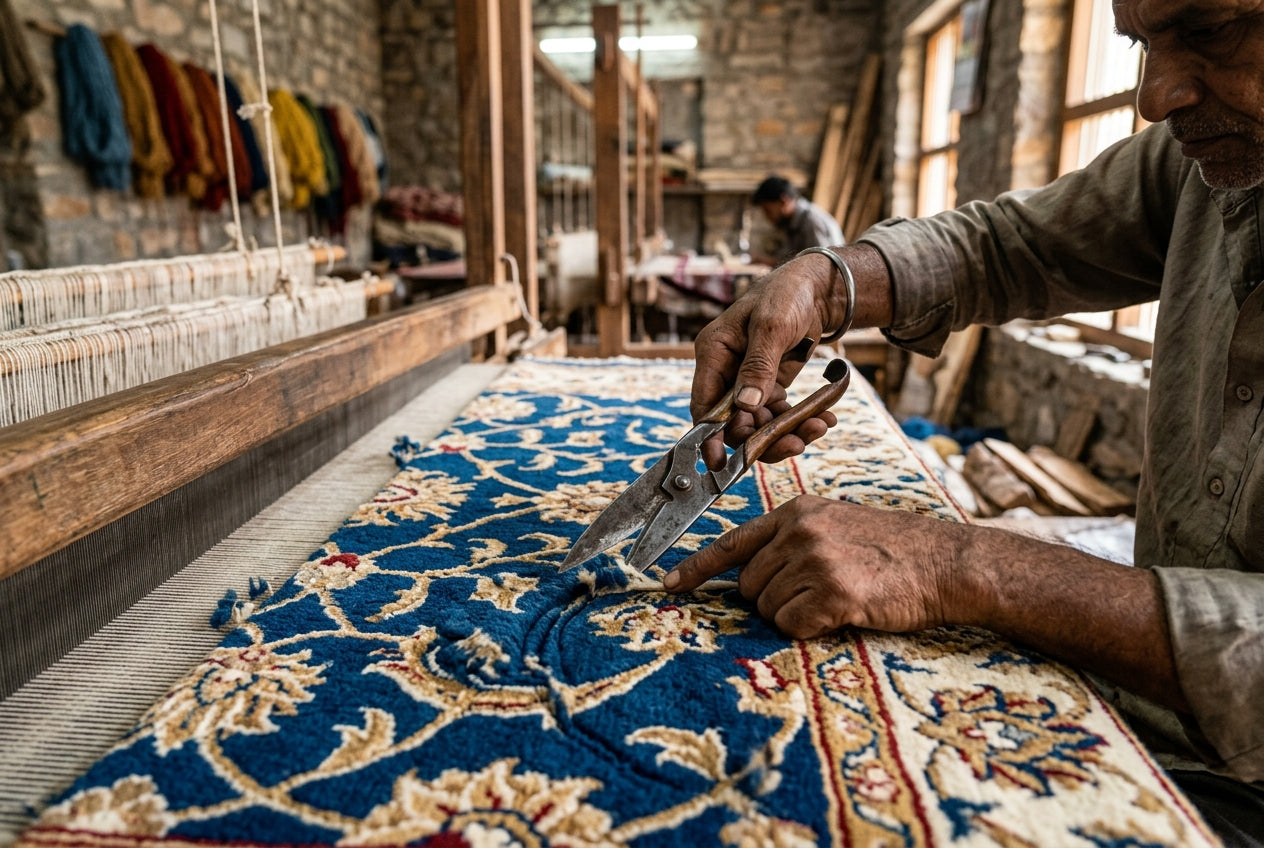
Tufting is still rigorous, skilled hand craftsmanship, but it is vastly more efficient than loom-knotting. A hand tufted wool rug requires about a quarter of the production time of a knotted piece of equal dimensions (Hali)—usually 4 to 8 weeks from initial framing to finished carpet. That major labor savings is the primary reason for the dramatic price difference.
What this means for you: Tufting is superior at rendering bold graphic shapes, fluid color gradients, sweeping curves, and sculpted multi-level textures—the defining hallmarks of modern, mid-century, and abstract rug design. Knotting is superior for microscopically fine geometric repetition, traditional Persian florals, and ornate heritage borders.
Hand-Tufted vs Hand-Knotted: Side-by-Side Comparison
| Feature | Hand-Knotted Rug | Hand-Tufted Rug (ThePieCraft) |
|---|---|---|
| How it's made | Individual knots tied by hand, one by one on a loom | Yarn punched through stretched canvas with a hand-held tufting gun |
| Production time (8x10) | About 4–6 months | About 4–8 weeks |
| Typical lifespan | Decades to generations (50–100+ years) | 15–25 years with premium wool & regular care |
| Price point | Highest ($1,500 – $10,000+) | Accessible luxury (usually less than half of knotted) |
| Back of the rug | Knots clearly visible; exact design shows through | Covered with durable woven cotton duck backing |
| Feel underfoot | Firm, dense, flat profile | Soft, thick, plush, and deeply cushioned |
| Design strengths | Intricate traditional medallions, micro-florals | Bold modern shapes, waves, arches, 3D carved textures |
| Initial shedding | Minimal to light | Moderate for first few weeks, then settles with suction vacuuming |
| Reversibility | Occasionally reversible (flatweaves / sumaks) | Single-sided (backing side down) |
| Best suited rooms | Formal sitting rooms, dining rooms, heirloom collections | Living rooms, bedrooms, nurseries, family spaces, offices |
*Lead times and lifespan figures documented by FCI London and Hali International Carpet Journal.
Why Are Hand Knotted Rugs So Expensive? (Hand Knotted vs Hand Tufted Value)
Mostly, you're paying for months of an artisan weaver's undivided time. Raw wool and silk costs make up only a modest slice of the retail price. The remainder is pure manual labor: a single 8x10 hand-knotted carpet holds between 800,000 and 1,500,000 individual knots. Someone literally sat at a wooden loom and tied every single one by hand.
Fine hand-knotted rugs also have a unique financial characteristic: some antique and museum-grade high-KPSI pieces hold or appreciate in value over decades. Hand-tufted rugs very rarely appreciate in monetary resale value. If your objective is purchasing an investment commodity or creating an inheritance piece to hand down to your grandchildren in the year 2080, hand-knotted is the unquestioned choice. But if you are purchasing a gorgeous, comfortable, artistic handmade area rug to anchor your family living room for the next 15 to 20 years, paying triple for knots you can't feel doesn't make financial sense.

Abstract Flow Rug — New Zealand Wool & Viscose
Featuring sculptural organic contours, an ultra-plush 14mm pile, and natural stain-repelling lanolin. Hand-tufted with New Zealand wool and hand-carved relief channels for luxurious living spaces.
Are Hand Tufted Rugs Good Quality? Lifespan & Materials
Yes, absolutely—when they are made with authentic materials. And that "when" matters far more for tufted rugs than almost any other home textile.
Lifespan estimates across internet forums and sales listings vary wildly. Some knotted-rug dealers unfairly claim hand-tufted rugs last only 3 years. At the other end, independent luxury home furnishing experts place well-made wool tufted rugs at 15 years in active family spaces (Hali) and up to 15 to 25 years with routine care (FCI London). The difference between a 3-year throwaway rug and a 20-year centerpiece comes down strictly to three anatomical factors:
- The wool fiber quality: Long-staple wool—specifically authentic New Zealand wool rug yarn—possesses a natural spring-like spiral crimp that repeatedly rebounds when stepped on and stubbornly resists matting. In contrast, short-staple scrap wool or synthetic polyester flattens permanently within months.
- Tuft density (yarn weight): Greater yarn density per square inch prevents fibers from collapsing under furniture or foot traffic. When you press your thumb firmly into a well-crafted tufted rug, the dense pile immediately pushes back against your hand.
- The backing and latex chemistry: Low-grade mass-produced rugs use cheap, chalk-filled synthetic adhesives that dry out, crack, crumble into white dust, and release a noxious petrochemical odor. High-end artisan workshops in Bhadohi use high-grade natural vulcanized latex beneath heavy woven cotton canvas, maintaining flexible structural integrity for decades.
How long do hand tufted rugs last? A well-made 100% hand tufted wool rug in a busy living room, vacuumed weekly on suction mode and rotated twice a year, will comfortably last 15 to 25 years. A cheap machine-printed synthetic rug will show traffic lanes in three.
Do Hand Tufted Rugs Shed? What to Expect with Real Wool
Yes, initially—and this is 100% natural. Every hand-tufted wool rug has a cut pile. When artisans shear the face of the rug to an even height, thousands of microscopic loose yarn tips remain settled between the dense fibers. As you walk across the rug during the first few weeks, these residual fibers naturally migrate to the surface.
If you see fluff in your vacuum canister, do not panic. Simply vacuum regularly using a suction-only setting (beater bar/roller brush switched completely off). Within 4 to 8 weeks, shedding tapers off dramatically. Shedding is the hallmark of authentic natural sheep's wool—synthetic polyester or polypropylene rugs shed less initially, but they flatten rapidly and cannot be rejuvenated.
How to Tell a Hand-Tufted Rug from a Hand-Knotted Rug
Flip the corner of the rug over. That is the quickest and most foolproof test in the rug world.
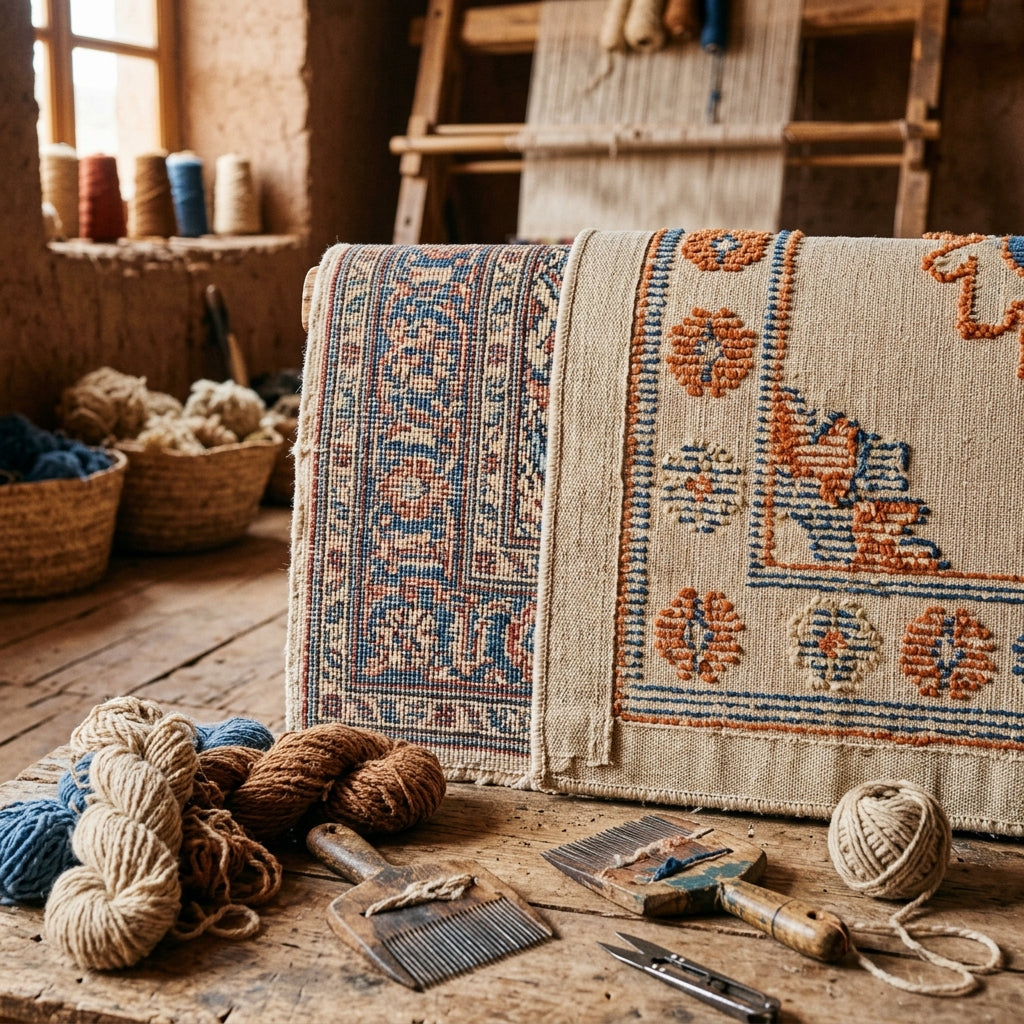
- On a hand-knotted rug: You will see the entire design mirrored on the back, composed of hundreds of thousands of tiny individual knots in neat rows. If you look closely, individual knots may vary slightly in size, which confirms human handwork. Furthermore, any fringe at the ends is not sewn on—it is the exposed 끝 of the warp threads, forming an integral part of the rug's internal skeleton.
- On a hand-tufted rug: The reverse side is completely covered by a flat fabric backing, usually heavy cotton duck or canvas. The front design is hidden beneath this cloth. If the rug has fringe, it has been sewn or glued onto the perimeter as a decorative border.
💡 Pro Buyer Tip: If an online seller or showroom salesperson refuses to show you clear, close-up photographs of the reverse side of a rug, ask why. Authentic rug makers are proud to show the back of every weave.
Which One Should You Buy? A Room-by-Room Guide
Forget the outdated notion of which construction is universally "better". The real question is which construction suits your room, your lifestyle, and how your family uses the space:
- Living Room: Hand-tufted is the stronger choice for 90% of modern homes. You get a soft, deeply cushioned surface for sitting and lounging, contemporary sculpted aesthetics, and large room-anchoring dimensions (such as an 8x10 or 9x12 ft) at a price that leaves ample budget for other furnishings. Reserve hand-knotted rugs for formal sitting rooms or heirloom dining spaces where generational longevity and flat drape are paramount (such as our Oushak, Heriz, and Kazak designs). Consult our Rug Size Guide for exact layout clearances.
- Bedroom: Hand-tufted. Your bare feet touch the floor first thing in the morning, meaning plush pile height and softness matter vastly more than knot density. Because bedroom foot traffic is exceptionally light, a well-made wool tufted rug will easily last two decades here.
- Dining Room: Either construction works well. Choose a low-to-medium dense pile (10mm to 12mm) so dining chair legs glide effortlessly without catching. Pure wool's organic lanolin coating creates high surface tension that slows down liquid absorption, giving you plenty of time to blot dinner party spills (Ernesta).
- Kids' Playrooms & Family Dens: Hand-tufted. High-traffic family zones are tough on floors. It makes far better financial sense to invest in 100% stain-resistant New Zealand wool than to pay triple for delicate museum knot counts.
- Home Office: Hand-tufted with a low, dense pile so caster wheels on office chairs roll smoothly without sinking.
- Heirloom Investment: Hand-knotted, every time.

Arches Geometric Hand-Tufted Rug
Inspired by Mediterranean architecture, this striking geometric piece blends olive, terracotta, and warm taupe tones with precision hand-sheared relief contours. Handcrafted in Bhadohi from pure natural wool.
Why We Hand-Tuft Our Rugs in New Zealand Wool
At ThePieCraft, our rugs are hand-tufted by master craftspeople in Bhadohi, Uttar Pradesh—the historic town that has formed the epicenter of South Asia's carpet-making heritage for over 400 years. We chose hand-tufting deliberately.
Our aesthetic is contemporary: fluid abstract flows, architectural arches, organic contours, and sculpted ripples (see trending silhouettes in our 2026 Rug Trends Guide). Hand-tufting combined with scissor relief-carving articulates organic curves and high-low textural depth in ways that traditional vertical knotting cannot match.
We craft our rugs using New Zealand wool because fiber quality is what dictates a tufted rug's longevity. New Zealand wool features exceptionally long, naturally crimped staples that spring back after being compressed under heavy furniture. Its natural lanolin coating acts as a protective shield against beverage spills (Ernesta), while accepting eco-friendly dyes with luminous, enduring colorfastness.
📐 ThePieCraft Verified Production Specifications
- Pile Material: 100% Certified Pure New Zealand Wool (accented with botanical viscose on select styles)
- Backing Construction: Natural vulcanized latex core covered by heavy-duty 100% woven cotton duck canvas
- Standard Pile Height: 12mm to 16mm (offering plush sound dampening and thermal comfort)
- Available Standard Sizes: From 2x3 ft entry mats to 9x12 ft grand living room rugs
- Custom Orders: Bespoke dimensions, color matching, and freeform shapes crafted to order in 4 to 6 weeks (Custom Rugs Studio)
- Global Delivery: Express door-to-door air shipping to the United States, Canada, United Kingdom, Australia, and the UAE in 5–12 business days with all import duties prepaid (DDP)
How to Make a Hand-Tufted Wool Rug Last 15+ Years
Follow these six proven golden rules to keep your hand-tufted rug looking brand new for decades:
- Vacuum weekly on suction only: Always turn off the motorized rotating brush (beater bar). Rotating bristles yank at tufts, increase fuzzing, and accelerate fiber loss. Use a simple bare-floor suction head.
- Rotate twice yearly: Turn the rug 180 degrees every six months so sunlight and foot traffic distribute evenly across the weave.
- Blot spills immediately: Never scrub or rub in circles. Press firmly with a dry white microfiber cloth, working from the outside edge toward the center. Check our detailed guide on room setup and rug care.
- Always use a quality rug pad: A dual-sided felt-and-rubber pad prevents slipping, cushions every step, and absorbs floor pressure to protect the latex backing.
- Never soak in water: Never wash a tufted rug with a garden hose or submerge it. Saturating moisture degrades the latex compound. Spot clean only, and use professional low-moisture dry-extraction cleaning every 18 to 24 months.
- Snip sprouts, never pull: If an individual yarn tuft pops above the pile surface, snip it flush with scissors. Pulling can unravel surrounding tufts.
Terminology Decoded: Rugs and Carpets Difference (Plus Indoor vs Outdoor Rugs)
When decorating a home, buyers frequently ask about the essential rugs and carpets difference. While the terms are sometimes used interchangeably in casual conversation or British/Indian English, they serve fundamentally different functions in architecture and interior design:
- Rugs (Area Rugs): An area rug is a moveable textile floor covering with finished, bound or serged edges. It is designed to float over existing flooring (such as hardwood, tile, or polished concrete), framing dedicated conversation or sleep zones while leaving perimeter borders exposed. Rugs offer flexible styling, easy cleaning, and move with you when you relocate.
- Carpets (Wall-to-Wall Carpeting): A carpet traditionally refers to permanent, wall-to-wall broadloom flooring that is stretched, cut, and permanently tacked down over underlayment across an entire room from baseboard to baseboard. Once installed, wall-to-wall carpet cannot be easily rearranged, washed outdoors, or rotated.
Another common question is how natural indoor wool rugs compare to synthetic outdoor rugs. Outdoor rugs are crafted almost exclusively from petroleum-derived plastic fibers—primarily UV-stabilized polypropylene, recycled PET, or polyester—engineered to withstand torrential rain, mildew, and direct exterior sunlight on open patios, verandas, and poolside decks. While great for backyards, synthetic outdoor rugs feel rough, abrasive, and plasticky under bare feet, and lack the acoustic absorption, thermal insulation, and natural flame-retardant safety that make New Zealand wool rugs indispensable for luxury interior living spaces.
Transform Your Living Room with Pure Hand-Tufted Wool
Explore 125+ original handcrafted area rugs hand-tufted from New Zealand wool by master artisans in Bhadohi. Exceptional resilience, natural stain resistance, and cloud-soft underfoot luxury.
Frequently Asked Questions
What is the main difference between hand-tufted and hand-knotted rugs?
Hand-knotted rugs are tied knot by knot on a loom, which takes 4 to 6 months of intense labor. Hand-tufted rugs are made by punching yarn through canvas with a hand-held tufting gun and securing it with latex and cotton backing, which takes 4 to 8 weeks. Knotted rugs last longer as heirlooms, while tufted rugs are softer, more affordable, and vastly better suited to modern sculpted designs.
Is hand-tufted better than hand-knotted?
Neither construction is universally better; they serve different purposes. Hand-knotted is superior for collectors, formal heirloom preservation, and ultra-fine traditional Persian florals. Hand-tufted is vastly better value for modern living rooms, bedrooms, and contemporary homes seeking plush underfoot cushioning, rich sculpted textures, and sensible pricing.
How long do hand-tufted rugs last?
A well-made hand-tufted wool rug crafted with long-staple New Zealand wool typically lasts 15 to 25 years when maintained with weekly suction vacuuming, semi-annual rotation, and a protective rug pad. Rugs made with short synthetic fibers or brittle latex can wear out in 3 to 5 years.
Why are hand-knotted rugs so expensive?
A single large 8x10 hand-knotted rug requires a master weaver to tie over one million individual knots over 4 to 6 months. You are primarily paying for months of skilled artisan labor rather than raw wool materials.
Do hand-tufted rugs shed?
Yes, authentic wool tufted rugs naturally shed loose fiber ends left from the shearing process during the first 4 to 8 weeks. Regular suction-only vacuuming quickly clears this residual fuzz, after which shedding drops significantly.
Can you wash a hand-tufted rug?
No, you must never soak a hand-tufted rug in water or wash it with a garden hose. Excessive water dissolves and rots the latex backing compound. Promptly blot fresh spills and use professional low-moisture dry-cleaning for comprehensive refreshes.
Are hand-tufted rugs good for homes with pets?
Yes. Natural wool naturally repels stains, resists liquids due to its natural lanolin barrier, and resists odors significantly better than petroleum synthetics. Choose a medium cut pile (12mm) and snip any snagged loops flush rather than pulling.
Find Your Handcrafted Area Rug
If you want a soft, modern wool rug that looks like a sculptural masterpiece and is built for everyday living, a hand-tufted rug is the smart investment. Browse our complete artisan collection, shipped directly from our workshops to your doorstep in the US, UK, Australia, and worldwide.