

Cleaning Guide
Do Wool Rugs Shed? Why It Happens, How Long It Lasts & How to Stop It (The Artisan Care Guide)

You unroll your brand-new, luxurious hand-tufted wool rug, step onto its plush, velvety pile, and immediately fall in love with the warmth and craftsmanship. But within forty-eight hours, you notice small tumbleweeds of fluffy fibers collecting around the edges, clinging to your socks, or filling your vacuum canister. Panic sets in: Is my rug defective? Is it falling apart? Did I waste hundreds of dollars on a low-quality rug?
First, take a deep breath: your rug is not ruined, and it is not defective. In fact, shedding is the single most common, completely natural characteristic of authentic 100% natural wool. From high-end showroom rugs to heirloom carpets made by master weavers in Bhadohi, all natural wool rugs shed during their initial break-in period.
In this definitive artisan guide, we explain the textile biology behind wool shedding, reveal why cheap synthetic rugs never shed (and why that's actually a bad thing), outline the exact timeline for when shedding stops, and provide the weaver's rulebook on how to dramatically reduce shedding without damaging your rug's fibers.
⚡ The Quick Summary: Wool Rug Shedding Facts
- Why It Happens: Natural wool is spun from natural staple fibers. During weaving, tufting, and shearing, shorter loose fibers become trapped in the dense pile. Foot traffic and gentle vacuuming simply work these loose fibers to the surface.
- How Long It Lasts: With proper care, 80% of shedding subsides within the first 4 to 8 weeks. Minimal incidental shedding may continue for up to 6 months before stabilizing completely.
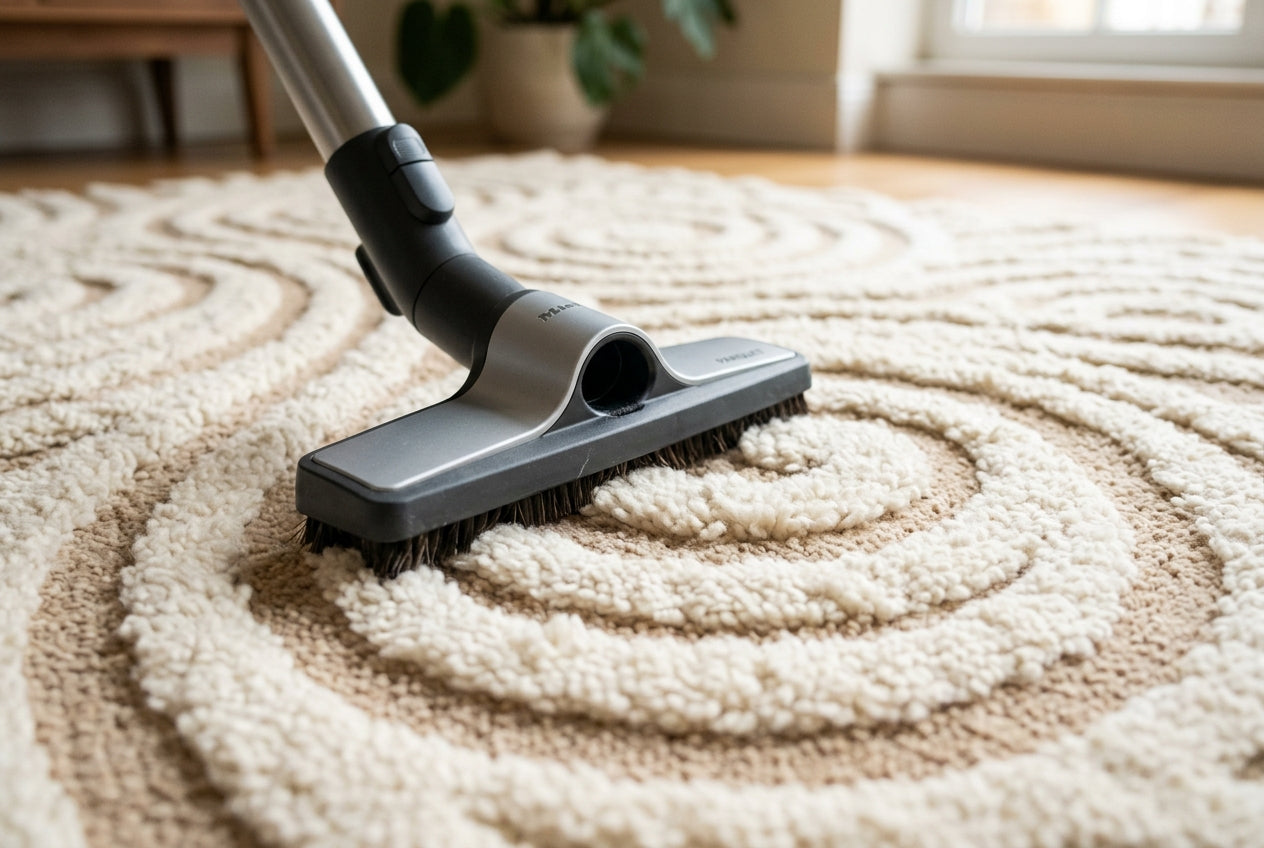
- The #1 Mistake: Using an upright vacuum with an aggressive rotating beater bar or stiff motorized roller brush. The rotating bristles yank and tear healthy wool fibers, creating infinite artificial shedding!
- The Fix: Switch your vacuum to suction-only mode, vacuum once or twice weekly in the direction of the pile, and use a high-density felt rug pad underneath.
1. The Biology of Wool: Why Do Wool Rugs Shed?
To understand why your rug sheds, you have to look at how wool is harvested and spun. Unlike synthetic carpet fibers (such as polyester or polypropylene), which are extruded as endless, unbroken plastic filaments miles long, sheep wool consists of natural staple fibers—individual strands of wool hair typically measuring 3 to 6 inches in length.

When master spinners in Bhadohi twist these staple fibers into durable yarn, thousands of microscopic fiber ends remain along the yarn's body. During the manufacturing process of hand-tufted wool rugs, several crucial mechanical steps take place:
- Tufting: A handheld tufting gun punches looped wool yarn through high-tensile cotton canvas at speeds of up to 1,000 punches per minute.
- Latex Bonding: The back of the loops is permanently sealed with natural latex and backed with heavy cotton cloth. The base of the fiber is locked in place forever.
- Shearing & Leveling: The looped surface is clipped open with heavy motorized shearing blades to create a soft, velvety cut pile. This shearing process cuts across millions of fibers simultaneously.
- Hand-Carving: Artisans use curved hand shears to carve sculptural bevels and dimensional 3D relief lines between color blocks and geometric forms.
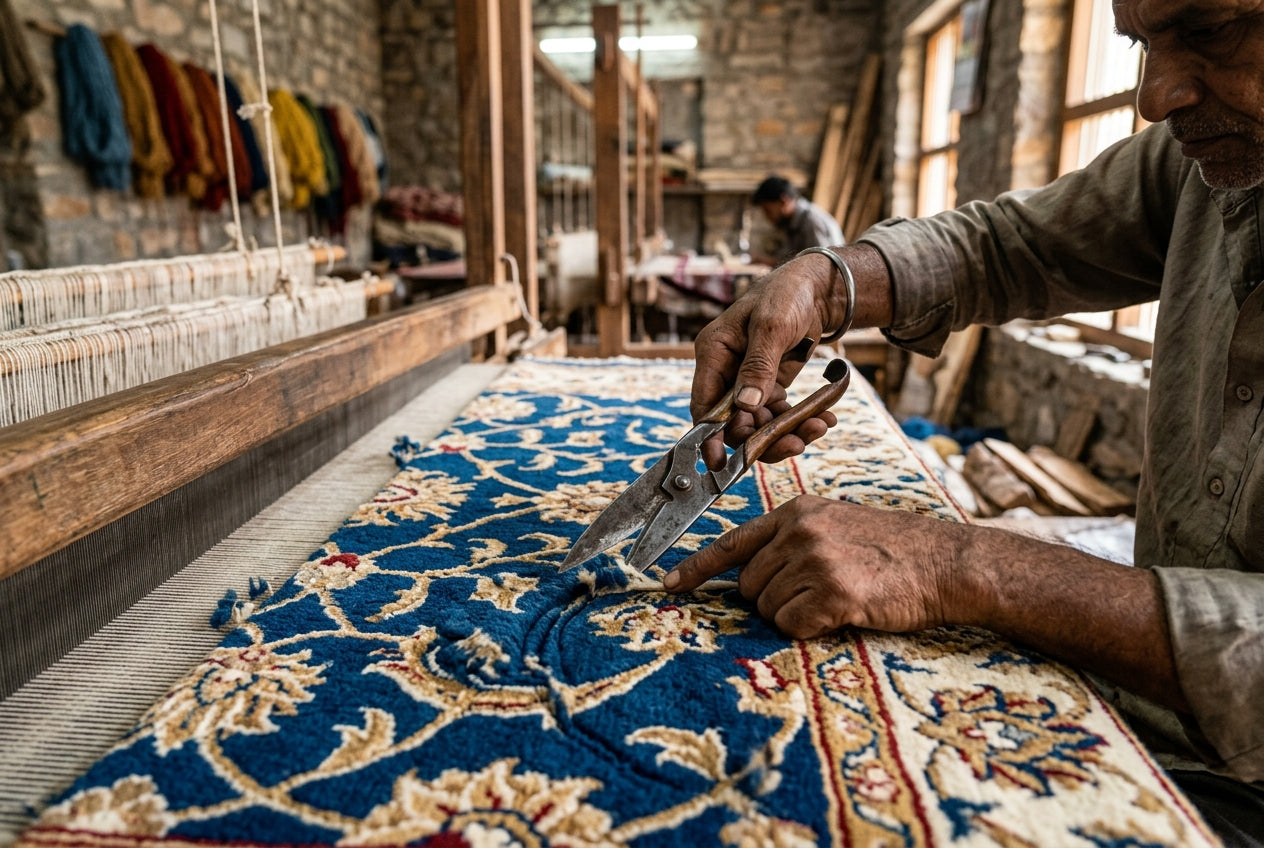
Although every rug is thoroughly vacuumed and beaten in our Bhadohi facility before shipping, millions of microscopic trimmings remain nested deep between the densely packed tufts. When you walk on the rug, your weight compresses the pile, squeezing these trapped clippings upward to the surface like toothpaste from a tube. You are not losing the rug's body—you are simply clearing out the leftover barber's clippings!
2. Hand-Tufted vs. Hand-Knotted: Which Sheds More?
While all wool rugs shed initially, different weaving constructions behave differently:
| Rug Construction | Initial Shedding Intensity | Duration of Shedding | Why It Behaves This Way |
|---|---|---|---|
| Hand-Tufted Cut Pile | Moderate to High (Weeks 1–4) | 4 to 10 weeks | Thick, dense pile with sheared cut tips and deep artisan carvings releases more surface trimmings. |
| Hand-Knotted Pile | Low to Moderate | 3 to 6 weeks | Individual knots tied around warp threads grip fibers tightly; lower pile height holds fewer clippings. |
| Hand-Tufted Loop Pile | Very Low | 1 to 3 weeks | Yarns remain in continuous unbroken loops, eliminating cut tips almost entirely. |
| Machine-Made Synthetic | Zero Shedding | None | Plastic filaments (polypropylene/polyester) don't shed—they simply crush, mat, and degrade permanently. |
3. Why Synthetic Rugs Never Shed (And Why Wool Is Worth It)
Big-box retailers often advertise that cheap synthetic rugs "never shed." While technically true, this is nothing to brag about. Synthetic rugs are manufactured from petroleum plastics (polypropylene, nylon, and polyester). Because plastic is melted and pulled into unbroken fishing-line-like filaments, there are no natural staple fibers to shed.
However, what mass-market retailers don't tell you is the trade-off:
- Plastic Doesn't Shed—It Mats: When footsteps crush synthetic fibers, they snap and bend permanently. After 12 months, a synthetic rug develops dull, flat, greasy-looking traffic paths that cannot be revived.
- Microplastic Dust: While synthetic rugs don't produce fluffy tumbleweeds, vacuuming them breaks off microscopic plastic shards that enter your household air and lungs.
- Chemical Off-Gassing: Synthetics off-gas volatile organic compounds (VOCs) that pollute your indoor breathing zone.
By contrast, New Zealand wool is a living, resilient natural protein. It sheds its excess outer fluff initially, but the underlying pile remains springy, elastic, and luxurious for 15 to 25+ years.
4. The Step-by-Step Rulebook: How to Stop Wool Rug Shedding Fast
Follow these four weaver-tested rules to accelerate your rug's stabilization period and reduce fuzz by up to 70% in the first month:
Step 1: Turn OFF the Vacuum's Beater Bar (Crucial!)
The single greatest cause of prolonged, aggressive shedding is the motorized brush roll (beater bar) found on standard upright vacuums (like Dyson, Shark, or Hoover). The stiff plastic bristles spin at thousands of RPMs, violently grabbing, snagging, and ripping healthy wool fibers straight out of the tufted backing! This creates an artificial, endless cycle of shedding.
- Switch your vacuum to "Hard Floor" or "Suction Only" mode.
- If your vacuum does not have a brush shut-off switch, raise the height adjustment to the highest setting so the brush roll does not make aggressive contact with the pile.
- Better yet, use a canister vacuum with a smooth floor head attachment.
Step 2: Vacuum Once or Twice Weekly (In One Direction)
During the first 4 to 6 weeks, vacuum your rug once or twice a week. Do not vacuum aggressively back and forth in rapid scrubbing motions. Instead, move the vacuum head slowly in long, smooth passes in the direction of the pile grain (pet the rug with your hand—the smooth direction is the grain; the rough direction is against the grain).
Step 3: Invest in a Dense Felt Rug Pad
Under-rug friction accelerates pile breakdown. When you step on a rug resting directly on a hard subfloor, the horizontal shear forces cause the wool fibers to rub vigorously against each other. A thick, dual-surface felt-and-rubber rug pad absorbs 60% of the downward impact shock, reducing internal pile abrasion and significantly slowing fiber release.
Step 4: Clip "Sprouts" with Scissors—Never Pull Them!
During the first few months, you may spot a single yarn tuft standing taller than the rest of the pile (known in the weaving trade as a "sprout"). This occurs when a tuft was slightly folded during tufting and finally pops upright with foot traffic.
Never pull a sprout with your fingers! Pulling can unravel neighboring stitches. Instead, take sharp household or fabric scissors and carefully snip the protruding fiber flush with the surrounding pile surface.
5. Troubleshooting: When Is Shedding NOT Normal?
While shedding loose fluff is 100% natural, you should know the difference between healthy initial shedding and structural failure:
| Observation | Healthy Normal Shedding | Defective Low-End Rug |
|---|---|---|
| Texture of Debris | Soft, fluffy wool fuzz and lint | Entire yarn strands pulling out intact; white sandy powder falling from back |
| Pile Appearance | Pile remains dense, thick, and consistent | Visible bald spots, hollow patches, or exposed backing canvas |
| Shedding Timeline | Drops dramatically after 4–8 weeks | Continues shedding aggressively for years due to low-grade synthetic latex breakdown |
At ThePieCraft, we use exclusively premium, long-staple New Zealand wool and flexible, non-toxic natural latex that prevents backing powdering or premature pile loss.
Invest in Naturally Stain-Resistant Pure Wool Rugs
Tired of synthetic rugs that trap dirt and flatten out? Our New Zealand wool rugs feature natural lanolin stain resistance, effortless spot cleaning, and heirloom longevity.
Frequently Asked Questions About Wool Rug Shedding
Will vacuuming too much ruin my wool rug?
Vacuuming with suction-only will never harm a wool rug. However, vacuuming with an aggressive motorized brush roll every day will degrade the pile prematurely. Stick to gentle suction vacuuming once or twice weekly during the first month, and once weekly thereafter.
Can I wash my wool rug to stop shedding?
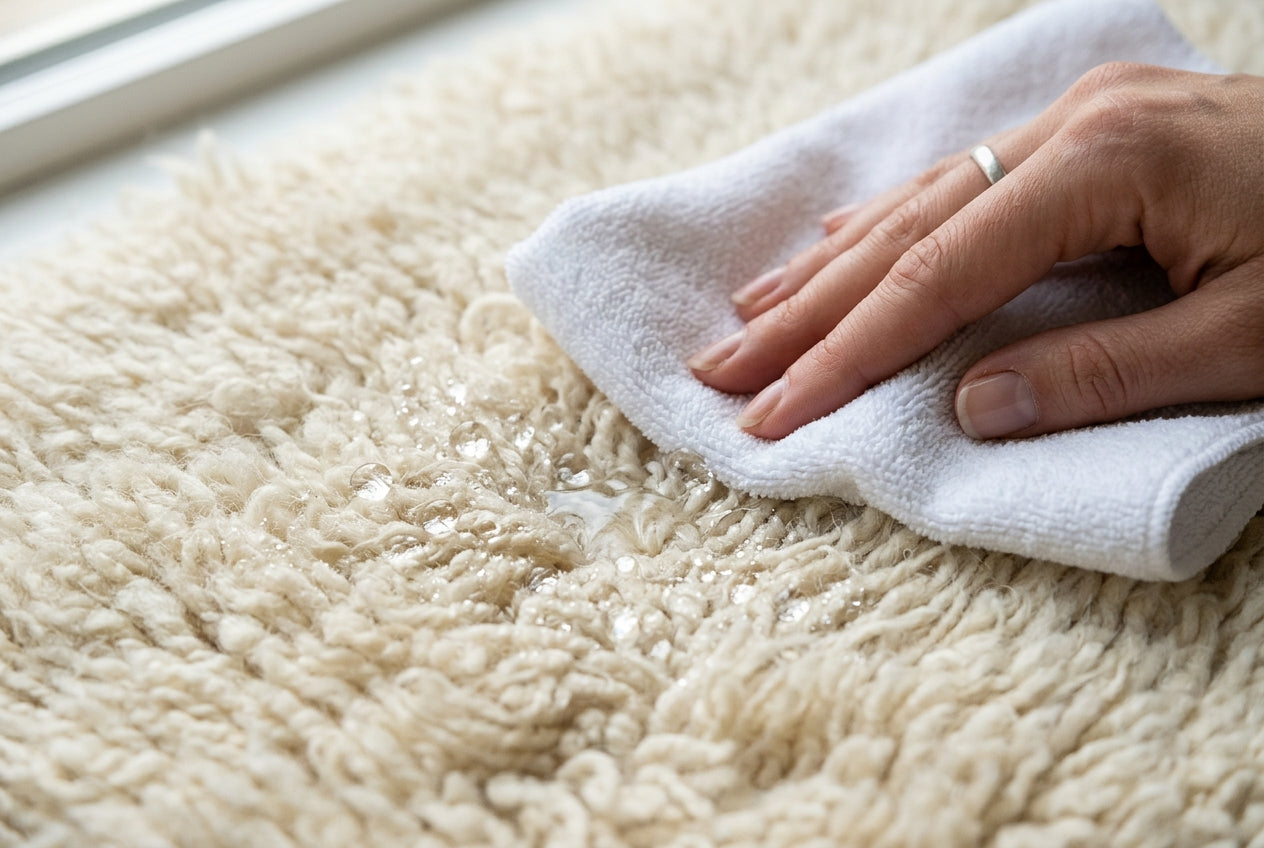
No! Never machine-wash or hose down a hand-tufted wool rug. Submerging the rug in water can weaken the natural latex adhesive holding the tufts to the cotton canvas backing. To clean spills, always blot gently with a dry white cotton towel and a gentle wool-safe detergent solution.
Do wool blend rugs shed less than 100% wool rugs?
Rugs blended with bamboo silk or viscose may produce slightly silkier, lighter lint, but they still shed during initial shearing release. However, blends containing cheap synthetic polyester often mat instead of shedding. For durability and heirloom quality, New Zealand wool remains the superior choice.
Invest in Enduring Natural Wool by ThePieCraft
Our hand-tufted rugs are crafted with New Zealand wool, expertly sheared, and built to last for decades. Discover our collection of signature designs with free worldwide express delivery (DDP).